Palo Alto Networks secured 95 of the Fortune 100, but hybrid work moved employees onto home networks the enterprise could not protect. Okyo Garde was created to close that gap: enterprise-grade security for the home, designed to create a new consumer-to-enterprise pull-through motion.
The User Problem. Few people wander the aisles of Best Buy looking for a “cybersecurity product.” But in their digital lives, they feel vulnerable and uncertain: Should I open this email? Can I trust this site? Are my kids protected? They want to feel safe at home without constantly monitoring, understanding, and reacting to every new threat.
So the product challenge was not just bringing Palo Alto’s security stack home. It was making invisible protection feel simple, trustworthy, and effortless enough for ordinary households to adopt.
Founding PM for the consumer mobile app and end-to-end consumer experience — the consumer voice inside Palo Alto's first B2C venture. Owned the consumer product strategy and the calls when it conflicted with enterprise instincts. Partnered with a hardware PM (Wi-Fi device) and platform PM (security stack) at the peer level, across two engineering managers and ~40 engineers.
Because PANW had never shipped a B2C product, also built the consumer operating muscle the company didn't have — ecommerce, growth, and CS — and hired two PMs as we scaled internationally.
Cognitive simplification over capability.
Consumer adoption depended on reducing cognitive load, not adding advanced controls and features. It unlocked a buyable consumer cybersecurity category that didn't previously exist; a competitive frame neither incumbent set was built to defend (Eero/Nest competed on Wi-Fi performance, McAfee/Norton on software protection); and the trust signal that drove household word-of-mouth — and ultimately the pull-through to enterprise.
- Simplicity vs. configurability: Reduced advanced controls and enterprise-style policy depth because consumers needed confidence, not admin complexity.
- Visibility vs. anxiety: Made threats visible enough to build trust, while avoiding alert overload, fear, and technical detail that could make users feel responsible for managing security.
- Self-serve vs. assisted setup: Prioritized scalable self-serve onboarding, but added white-glove installation where setup complexity would otherwise block adoption.
Okyo Garde was a consumer cybersecurity system — Wi-Fi hardware, Palo Alto Networks' cloud security stack, mobile app, onboarding, subscriptions, e-commerce, support, and optional installation — brought together into one household experience.
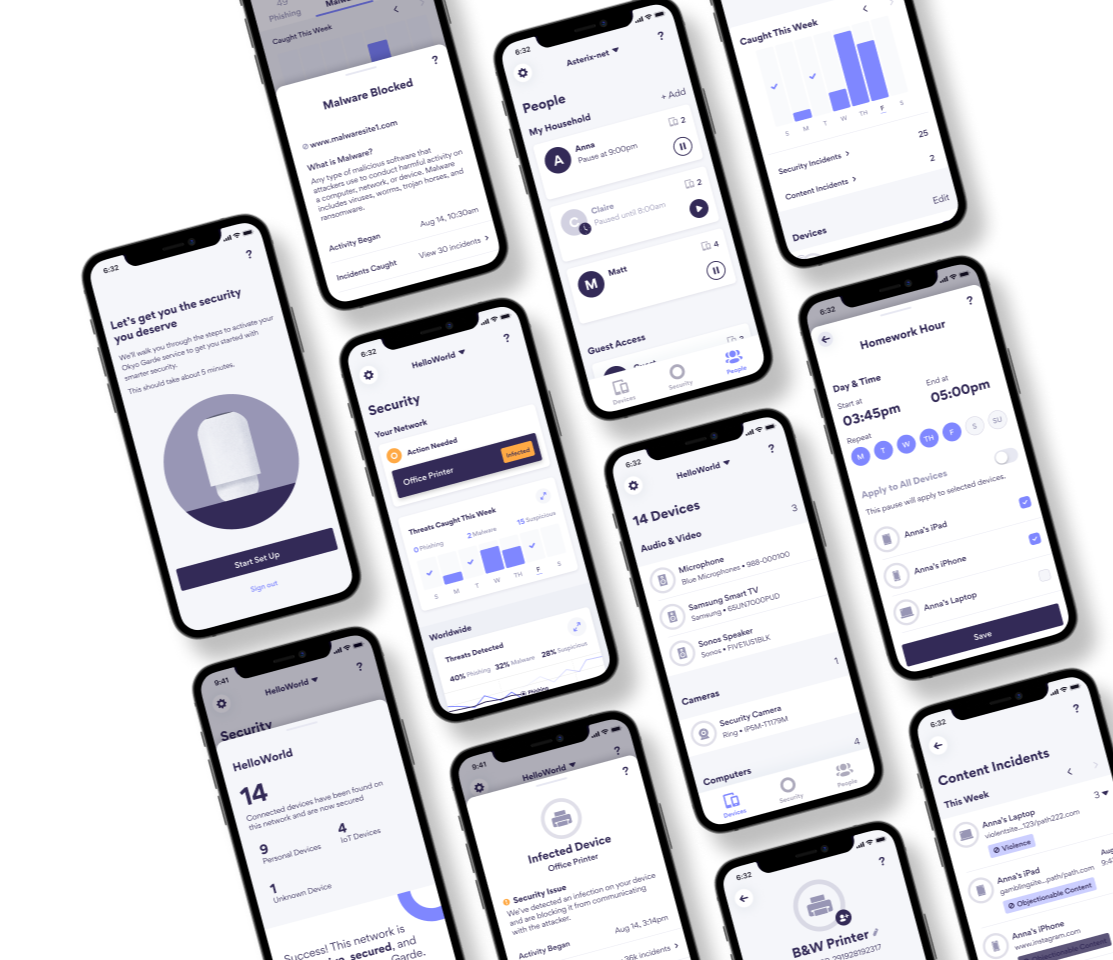
- Consumer mobile app: Owned the app experience that translated enterprise security into simple household concepts: protection status, connected devices, alerts, and recommended actions.
- Seamless onboarding: Rebuilt setup to migrate existing Wi-Fi credentials and avoid manual device reconnection, reducing setup from ~40 minutes to under 5.
- Simplified visibility: Built plain-English threat dashboards so users could understand events like a smart thermostat contacting a foreign server at 2 AM without knowing packet inspection, ports, or security policy.
- Automated security: Designed presets and response workflows that resolved most threats without user intervention, surfacing only the moments that required action.
- Growth and operations layer: Built subscription journeys, upgrade moments, lifecycle engagement, app operations, CX feedback loops, and white-glove installation pilots to support retention, expansion, and scale.
- $15M first-year U.S. revenue
- 4.8★ App Store rating
- 75% → 97% activation after onboarding redesign; onboarding became the #1 cited strength in reviews
- $2M incremental revenue from white-glove installation pilots across 3 cities
- Enterprise pull-through: employee adoption at home led CISOs to request pilots for workforce/home-office security
- Featured on CNN and presented by Palo Alto's CEO as a flagship B2C venture