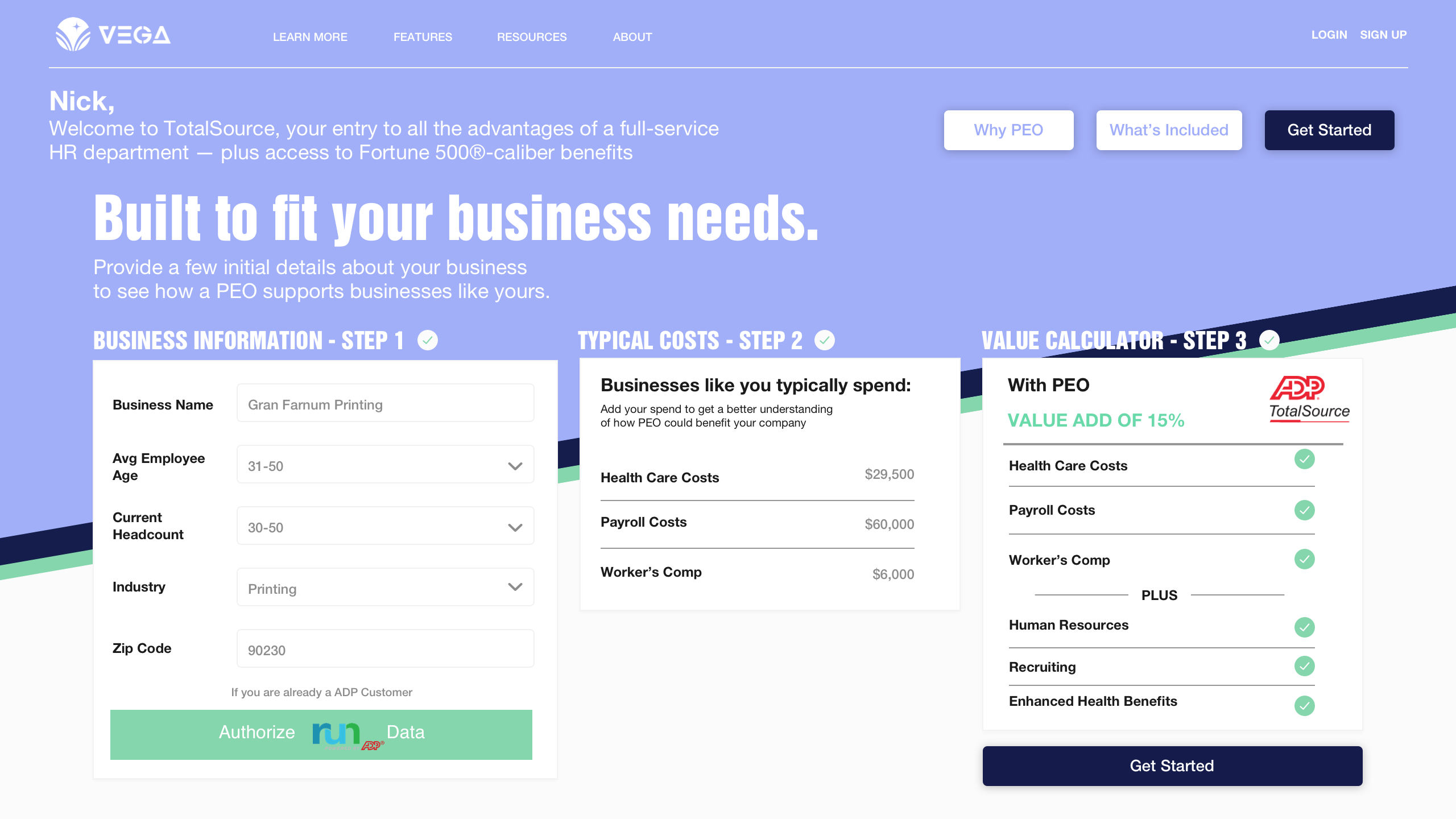
ADP was pivoting toward small businesses — a strategic shift from its enterprise-focused core. Its $200M PEO offering (bundled payroll, benefits, insurance, and compliance) had seen conversion drop 15% over three quarters. Because PEO had always sold through high-touch sales, the obvious move was to build sales enablement tools.
THE USER PROBLEM. PEOs are genuinely complex — costs, coverage, and fit vary by business. SMB owners without prior HR experience needed time to learn before they could evaluate. But the sales motion required qualification upfront — so SMBs pulled back before seeing value, and reps abandoned the slow leads. The real problem wasn't sales execution — it was that the sales motion didn't match how SMB owners wanted to engage: on their pace, with space to learn before deciding.
As the product lead, owned the product strategy and the call to propose a self-serve motion that threatened the field sales channel. Partnered at the peer level across product, design, data science, underwriting, and sales — led a cross-functional team of 8.
Because ADP had no precedent for self-serve in PEO, also built the validation muscle the company didn't have — experimentation and testing for customer-preference evidence, a co-designed predictive lead scoring model, and a compensation attribution framework that kept field reps whole as the pivot launched.
Self-serve product over sales enablement.
The path to SMB growth required redesigning — not augmenting — the commission-based field sales channel that had built ADP's PEO business. It unlocked access to the micro-SMB segment the high-touch motion couldn't economically serve; a scalable sales model where rep headcount no longer capped volume; and a template ADP later codified for other product lines.
- Self-serve scale vs. sales rep commission: Accepted some commission redistribution because the high-touch motion couldn't economically serve micro-SMB volume; built compensation attribution to keep reps whole on what they could still influence.
- Pricing transparency vs. precision: Chose benchmarked "companies like yours" pricing over custom quotes — accepting imprecision because custom precision required the data SMBs wouldn't share until they saw pricing.
- Phased rollout vs. revenue speed: Narrowed launch to digitally-comfortable micro-SMBs (accountants, consultants, tax firms) before broader expansion, accepting slower ramp to de-risk the pivot and earn sales-org alignment before scaling.
We built ADP's first self-serve PEO buying workflow — a full-funnel experience moving SMB owners from education and consideration to underwriting review, initial recommendation, and contract readiness — plus the predictive scoring model that routed high-intent buyers to reps.
- Self-serve evaluation: Helped SMBs understand PEO fit, coverage options, and "companies like mine" benchmarks at their own pace.
- Guided data collection: Used plain-language prompts, anonymized defaults, and benchmarked assumptions to reduce blank-field paralysis across business, payroll, benefits, and coverage inputs.
- Document upload + underwriting review: Let users upload required documents directly in the flow, creating a cleaner path to underwriting review.
- Initial recommendation + pricing: Returned an initial plan recommendation and benchmarked pricing range before requiring a custom sales quote.
- Predictive scoring + lead routing: Co-designed the model that identified high-intent users and routed them to sales when they were ready.
- Sales attribution model: Built compensation attribution so self-serve could scale without breaking field-sales incentives.
- +22% conversion from the self-serve PEO buying workflow
- 60% reduction in lead-to-close cycle time
- $70M incremental revenue impact driven by higher conversion and improved sales productivity
- Codified as an ADP playbook for other product lines — including the methodology, sprint structure, validation approach, and decision framework